Logo image

Section 4.1 Matrices and Multiplication (MX1)

Subsection 4.1.1 Warm Up

Activity 4.1.1.

Suppose that \(T\colon V\to W\) is a linear transformation.
(a)
What is the definition of \(\ker T\text{?}\) How does it relate to the domain of \(T\text{?}\)
(b)
What is definition of \(\Im T\text{?}\) How does it relate to the codomain of \(T\text{?}\)

Subsection 4.1.2 Class Activities

Observation 4.1.2.

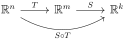
If \(T: \IR^n \rightarrow \IR^m\) and \(S: \IR^m \rightarrow \IR^k\) are linear maps, then the composition map \(S\circ T\) computed as \((S \circ T)(\vec{v})=S(T(\vec{v}))\) is a linear map from \(\IR^n \rightarrow \IR^k\text{.}\)
described in detail following the image
A representation of the composition of maps. The chain \(\IR^n \rightarrow \IR^m \rightarrow \IR^k\) is adorned with a \(T\) labeling the arrow from \(\IR^n\) to \(\IR^m\text{,}\) and a \(S\) labeling the arrow from \(\IR^m \rightarrow \IR^k\text{.}\) Below this is a curved arrow connecting \(\IR^n\) on the left to \(\IR^k\) on the right, which is labeled \(S \circ T\text{.}\)
Figure 45. The composition of two linear maps.

Activity 4.1.3.

Let \(T: \IR^3 \rightarrow \IR^2\) be defined by the \(2\times 3\) standard matrix \(B\) and \(S: \IR^2 \rightarrow \IR^4\) be defined by the \(4\times 2\) standard matrix \(A\text{:}\)
\begin{equation*} B=\left[\begin{array}{ccc} 2 & 1 & -3 \\ 5 & -3 & 4 \end{array}\right] \hspace{2em} A=\left[\begin{array}{cc} 1 & 2 \\ 0 & 1 \\ 3 & 5 \\ -1 & -2 \end{array}\right]\text{.} \end{equation*}
(b)
What size will the standard matrix of \(S \circ T\) be?
  1. \(\displaystyle 4 \text{ (rows)} \times 3 \text{ (columns)}\)
  2. \(\displaystyle 3 \text{ (rows)} \times 4 \text{ (columns)}\)
  3. \(\displaystyle 3 \text{ (rows)} \times 2 \text{ (columns)}\)
  4. \(\displaystyle 2 \text{ (rows)} \times 4 \text{ (columns)}\)
(c)
Compute
\begin{equation*} (S \circ T)(\vec{e}_1) = S(T(\vec{e}_1)) = S\left(\left[\begin{array}{c} 2 \\ 5\end{array}\right]\right) = \left[\begin{array}{c}\unknown\\\unknown\\\unknown\\\unknown\end{array}\right]. \end{equation*}
(f)
Use \((S \circ T)(\vec{e}_1),(S \circ T)(\vec{e}_2),(S \circ T)(\vec{e}_3)\) to write the standard matrix for \(S \circ T\text{.}\)

Definition 4.1.4.

We define the product \(AB\) of a \(m \times n\) matrix \(A\) and a \(n \times k\) matrix \(B\) to be the \(m \times k\) standard matrix of the composition map of the two corresponding linear functions.
For the previous activity, \(T\) was a map \(\IR^3 \rightarrow \IR^2\text{,}\) and \(S\) was a map \(\IR^2 \rightarrow \IR^4\text{,}\) so \(S \circ T\) gave a map \(\IR^3 \rightarrow \IR^4\) with a \(4\times 3\) standard matrix:
\begin{equation*} AB = \left[\begin{array}{cc} 1 & 2 \\ 0 & 1 \\ 3 & 5 \\ -1 & -2 \end{array}\right] \left[\begin{array}{ccc} 2 & 1 & -3 \\ 5 & -3 & 4 \end{array}\right] \end{equation*}
\begin{equation*} = \left[ (S \circ T)(\vec{e}_1) \hspace{1em} (S\circ T)(\vec{e}_2) \hspace{1em} (S \circ T)(\vec{e}_3) \right] = \left[\begin{array}{ccc} 12 & -5 & 5 \\ 5 & -3 & 4 \\ 31 & -12 & 11 \\ -12 & 5 & -5 \end{array}\right] . \end{equation*}

Activity 4.1.5.

Let \(S: \IR^3 \rightarrow \IR^2\) be given by the matrix \(A=\left[\begin{array}{ccc} -4 & -2 & 3 \\ 0 & 1 & 1 \end{array}\right]\) and \(T: \IR^2 \rightarrow \IR^3\) be given by the matrix \(B=\left[\begin{array}{cc} 2 & 3 \\ 1 & -1 \\ 0 & -1 \end{array}\right]\text{.}\)
(a)
Write the dimensions (rows \(\times\) columns) for \(A\text{,}\) \(B\text{,}\) \(AB\text{,}\) and \(BA\text{.}\)

Activity 4.1.6.

Consider the following three matrices.
\begin{equation*} A = \left[\begin{array}{ccc}1&0&-3\\3&2&1\end{array}\right] \hspace{2em} B = \left[\begin{array}{ccccc}2&2&1&0&1\\1&1&1&-1&0\\0&0&3&2&1\\-1&5&7&2&1\end{array}\right] \hspace{2em} C = \left[\begin{array}{cc}2&2\\0&-1\\3&1\\4&0\end{array}\right] \end{equation*}
(a)
Find the domain and codomain of each of the three linear maps corresponding to \(A\text{,}\) \(B\text{,}\) and \(C\text{.}\)
(b)
Only one of the matrix products \(AB,AC,BA,BC,CA,CB\) can actually be computed. Compute it.

Activity 4.1.7.

Let \(B=\left[\begin{array}{ccc} 3 & -4 & 0 \\ 2 & 0 & -1 \\ 0 & -3 & 3 \end{array}\right]\text{,}\) and let \(A=\left[\begin{array}{ccc} 2 & 7 & -1 \\ 0 & 3 & 2 \\ 1 & 1 & -1 \end{array}\right]\text{.}\)
(b)
Check your work using technology. Using Octave:
B = [3 -4 0 ; 2 0 -1 ; 0 -3 3]
A = [2 7 -1 ; 0 3 2  ; 1 1 -1]
B*A
    

Activity 4.1.8.

Of the following three matrices, only two may be multiplied.
\begin{equation*} A=\left[\begin{array}{cccc} -1 & 3 & -2 & -3 \\ 1 & -4 & 2 & 3 \end{array}\right] \hspace{1em} B=\left[\begin{array}{ccc} 1 & -6 & -1 \\ 0 & 1 & 0 \end{array}\right] \hspace{1em} C=\left[\begin{array}{ccc} 1 & -1 & -1 \\ 0 & 1 & -2 \\ -2 & 4 & -1 \\ -2 & 3 & -1 \end{array}\right] \end{equation*}
Explain which two can be multiplied and why. Then show how to find their product.

Activity 4.1.9.

Let \(T\left(\left[\begin{array}{c}x\\y \end{array}\right]\right)= \left[\begin{array}{c} x+2y \\ y \\ 3x +5y \\ -x-2y \end{array}\right]\) In FactΒ 3.2.12 we adopted the notation
\begin{equation*} T\left(\left[\begin{array}{c}x\\y \end{array}\right]\right)= \left[\begin{array}{c} x+2y \\ y \\ 3x +5y \\ -x-2y \end{array}\right]= A \left[\begin{array}{c}x\\y \end{array}\right] = \left[\begin{array}{cc} 1 & 2 \\ 0 & 1 \\ 3 & 5 \\ -1 & -2 \end{array}\right] \left[\begin{array}{c}x\\y \end{array}\right] \text{.} \end{equation*}
Verify that \(\left[\begin{array}{cc} 1 & 2 \\ 0 & 1 \\ 3 & 5 \\ -1 & -2 \end{array}\right] \left[\begin{array}{c}x\\y \end{array}\right] = \left[\begin{array}{c} x+2y \\ y \\ 3x +5y \\ -x-2y \end{array}\right]\) in terms of matrix multiplication.

Subsection 4.1.3 Individual Practice

Activity 4.1.10.

Given two \(n\times n\) matrices \(A\) and \(B\text{,}\) explain why the sentence "Multiply the matrices \(A\) and \(B \) together." is ambiguous. How could you re-write the sentence in order to eliminate the ambiguity?

Subsection 4.1.4 Videos

Figure 46. Video: Multiplying matrices

Subsection 4.1.5 Exercises

Subsection 4.1.6 Mathematical Writing Explorations

Exploration 4.1.11.

Construct 3 matrices, \(A,B,\mbox{ and } C\text{,}\) such that
  • \(\displaystyle AB:\mathbb{R}^4\rightarrow\mathbb{R}^2\)
  • \(\displaystyle BC:\mathbb{R}^2\rightarrow\mathbb{R}^3\)
  • \(\displaystyle CA:\mathbb{R}^3\rightarrow\mathbb{R}^4\)
  • \(\displaystyle ABC:\mathbb{R}^2\rightarrow\mathbb{R}^2\)

Exploration 4.1.12.

Construct 3 examples of matrix multiplication, with all matrix dimensions at least 2.
  • Where \(A\) and \(B\) are not square, but \(AB\) is square.
  • Where \(AB = BA\text{.}\)
  • Where \(AB \neq BA\text{.}\)

Exploration 4.1.13.

Use the included map in this problem.
Diagram Exploration Keyboard Controls
Key Action
Enter, A Activate keyboard driven exploration
B Activate menu driven exploration
Escape Leave exploration mode
Cursor down Explore next lower level
Cursor up Explore next upper level
Cursor right Explore next element on level
Cursor left Explore previous element on level
X Toggle expert mode
W Extra details if available
Space Repeat speech
M Activate step magnification
Comma Activate direct magnification
N Deactivate magnification
Z Toggle subtitles
C Cycle contrast settings
T Monochrome colours
L Toggle language (if available)
K Kill current sound
Y Stop sound output
O Start and stop sonification
P Repeat sonification output
Figure 47. Adjacency map, showing roads between 5 cities
  • An adjacency matrix for this map is a matrix that has the number of roads from city \(i\) to city \(j\) in the \((i,j)\) entry of the matrix. A road is a path of length exactly 1. All \((i,i)\)entries are 0. Write the adjacency matrix for this map, with the cities in alphabetical order.

  • What does the square of this matrix tell you about the map? The cube? The \(n\)-th power?

Subsection 4.1.7 Sample Problem and Solution

Sample problem ExampleΒ B.0.18.